
4 Ways to Stop Imposter Syndrome in Public Speaking

When people contact me for public speaking coaching, I’ve noticed that before we get to things like perfecting the craft of storytelling, refining a message, vocal qualities etc, I often need to convince the person they deserve the speaking platform they were given in the first place. This happens….a lot. From the most expert-y experts you can imagine.

If you know even a little about me, you know I’m not one to tell someone to “change their mindset” without giving CONCRETE, ACTIONABLE TO-DOs to make that happen. (My brain didn’t come with a “mindset” switch. Did yours?)

So here they are. Here are four things you can DO – as in, add to a to-do list and then check off – that will help you overcome your imposter syndrome and CREATE a confident mindset before your next speaking event.

1. Update Your Resume

I don’t mean run it through an AI to optimize your keywords. I mean BRAG. In whatever bullet point format you choose. Write down everything you’ve done –  every accomplishment, every metric, every award, every EVERYTHING you can think of.  

Did you do that? Ok, now read it. Read it over multiple times. You were asked to speak BECAUSE of this document not in spite of it. Bring that voice with you.

2. Define What an Expert Is

Clients will often tell me they think “everyone knows more than they do.” Alright fine. Let’s go with that for a moment. Define what an “expert” means to you. What qualities, certifications, knowledge, career benchmarks etc would you need to have that would let you consider yourself an “expert?” I’m serious, write it down. This isn’t an “in your head” exercise.

Now, look at what you wrote. Would that list have been different 10 years ago? 20 years ago? Think of your PAST SELF writing this list, how that list would be different, and how many of those qualities you NOW HAVE. There is always more to accomplish. Imposter syndrome makes us focus on what we haven’t done, rather than what we have. When you speak, you’re speaking from the WEALTH OF KNOWLEDGE that you’ve accumulated, not what you’ve yet to do.  

3. Do Some “And-So-If-Then” For Your Worst-Case Scenario.

Think of the worst-case scenario you’re worried about in your speaking. The most common imposter-syndrome related concern I hear is, “I’m afraid I’ll be asked a question I don’t know,” so let’s use that as the example.

“I’m afraid I’ll be asked a question I don’t know.”

AND?

“And then I’ll feel stupid.”

“SO, IF I don’t know the answer to every question, THEN I’m stupid?”

Well, hmm, when you put it that way, it sounds silly!

Folks, there are SO many things to know. Our world is PACKED with information. Nobody knows everything about everything. Zero people. In fact, the more of an expert someone is, the more they KNOW they don’t know everything.  It’s not a matter of IF you’ll be asked a question you don’t know, it’s WHEN, so use that energy to work on what you’ll say when you’re faced with that situation, not HOPING it never happens.

(BTW, my go to phrases are: “Huh! Well isn’t THAT a fantastic question! I’m going to have to chew on that and get back to you” OR, if it’s something super basic that has simply slipped my mind –  “Wow, I really feel like I should know that one. Computer must be having some data retrieval issues.”  Find a phrase that sounds like YOU and practice it.)

4. Learn Something New

Confidence defeats imposter syndrome, and learning new things makes us feel confident. Best way to always be learning? BE CURIOUS!

What’s the topic/subject/thing you’re feeling weird about? Go read a book about it! Go watch a video. Go read a blog. Just make sure it comes from a place of CURIOSITY, not FOMO. “Fear Of Missing Out” knowledge consumption comes from fear. It comes from a place of trying to learn everything about everything which is a goal you’ll never achieve. Curiosity comes from a place of strength. Experts are always curious to learn more. Not as a benchmark to reach, but as a habit to live.

Go learn something. Anything. It can be related to your subject, but it doesn’t have to be. Learning makes us confident, and confident people can bring their best to their speaking.

Going forward

Finally, people who have worked with me know that if it doesn’t fit on a Post-it Note, I’m not all about it. So, here is your To-Do Post-it. Go on. Take it.

And go own the room at your next speaking engagement because you earned it.

Want more speaking tips? Check out my book Speak with Confidence on Amazon.

Want one-on-one help for an upcoming speaking engagement? Learn more about what coaching entails, and reach out today EmilySchwartzSpeaks@gmail.com
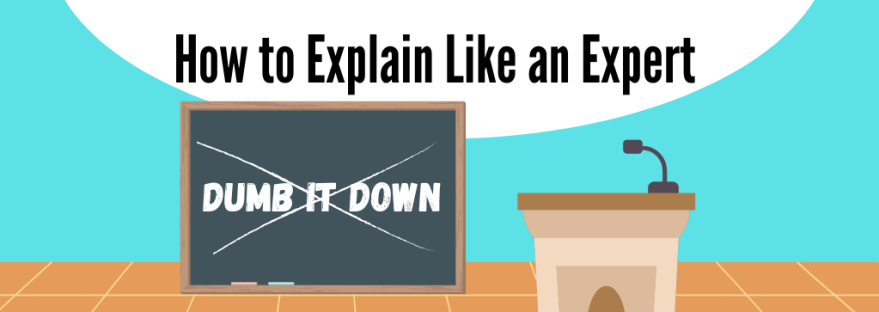

How to Explain Like an Expert

Let me set the scene:

Pretend that you’ve never seen the original Star Wars trilogy. Not only have you never seen it, you’ve never heard of it, never seen any merchandise for it, never heard of any of the characters, you are just now finding out about it for the first time.

You ask a friend, “Hey, so what’s this Star Wars thing all about?”

And THEY say, “Oh, it’s really cool, Darth Vader is Luke Skywalker’s father.”

(Feels like a weird “summary” right? Stick with me…)

Here is how I imagine the rest of that conversation playing out:

You: Who?

Them: Darth Vader! He’s Luke’s father!

You: Ok….but like, who IS that? What’s the movie about?

Them: ::louder and slower:: He’s HIS FATHER

You: Why does that matter? What’s the synopsis of the movie?


Them: His FATHER! Have you never heard of a father before? Why can’t you understand this?

You: I’ve now literally never wanted to see a movie less in my life.

Sound ridiculous? It is. But we do this all the time. We jump to the details, blow past the context, and get frustrated when the audience doesn’t follow. We repeat, slow down, say it louder, to no avail. The closer we are to a subject – the more it’s ingrained in our everyday lives, the easier it is to do.

It doesn’t have to be this way! Here’s one thing to STOP doing, and three things to START doing to explain things elegantly, like an expert.

Stop Dumbing it Down

When we are experts, and we’re strategizing how to present content to non-experts, the phrase “dumb it down” inevitably comes up. This is so backwards because “dumb” and “down” are both negatives, and simplicity is anything but. Simplicity is smart, engaging, and memorable.

Resist the urge to think of simplifying as “dumbing down.” Even with the best of intentions, this mindset can cause the speaker to come across as condescending, convoluted, and unrelatable. Your audience is an expert at something, just not the same thing as you. Try this instead:

Zoom Out

Instead of “dumbing down” think of it as “zooming out.” Upwards, not downwards. When people don’t understand something, it’s often because they lack CONTEXT. When you do a puzzle, do you look at the pieces first? No, you look at the box! Because otherwise none of the pieces make sense. You can’t see where things fit if you don’t know what picture you’re making.

If someone isn’t grasping what you’re trying to explain to them, ask yourself: “Have I shown this person the BOX? Or have I only shown them the pieces.”

Let’s go back to our Star Wars analogy for a moment. What if instead the conversation went like this:

You: “So….what is this Star Wars thing all about?”

Them: “Star Wars began as a sci-fi/fantasy trilogy set in space. The main conflict is between the Galactic Empire (the bad guys) and the Rebel Alliance (the good guys.) Darth Vader is one of the main villains fighting for the Empire. Luke Skywalker is one of the main protagonists fighting for the Alliance. Midway through the trilogy, Luke learns that Darth Vader, the villain he’s been fighting this whole time, is actually his father.

In both instances, your friend was giving you a vital plot point (or huge spoiler I guess) but this second explanation makes so much more sense because it includes the needed context. It includes the “zoom out.”

Relate to Known Knowledge

When teaching someone something new, start with what they KNOW and relate it to what they DON’T KNOW. This is why analogies are so effective. Here’s an example: An optometrist was explaining a type of contact lens to me. She told me it reshapes your eye to help you see better and that it was like getting braces but for your eyeballs. Now, I’m not an optometrist, nor do I currently wear contact lenses, but I’ve both seen and worn braces on my teeth before so I could instantly conceptualize what she meant.

In your content, look for relationships and processes that are similar to other relationships and processes that would be familiar to your audience. Once they have a basic understanding THEN you can add the details. It’s a form of learning theory called “scaffolding.” You know how a new building needs scaffolding around it so it can be accessed by construction workers before it’s ready to stand on its own? Learning is the same way. You’re bringing the learner along with just enough assistance, just enough context, just enough familiarity, until they can grasp it on their own.

Draw a Picture

Whenever you can use a visual instead of words, use the visual. A good, simple visual can be so much more impactful in the right circumstances than words. It’s why I appreciated my doctor telling me my daughter was the size of an avocado when I was pregnant instead of “4 inches” because while it’s difficult for me to accurately conjure a ruler in my head, I am extremely familiar with avocados. It’s why we talk about distances in terms of “football fields,” and use bar graphs and pie charts to display numerical data. Sometimes it’s hard to grasp a concept without a picture.

If you DO choose to use a visual representation, please, please, PLEASE make it simple. If it’s a graph with words, make the words big enough to see. If it’s a picture, make the lines bold and well contrasted. If your audience can’t see the visual, they’ll be so distracted trying to figure it out that they won’t be listening to you.

Always be a Learner

Finally, one of the best ways to be a good explainer is to always be a learner. Never lose site of the frustration and subsequent exhilaration of learning something new. It’s easier to be an expert when you’re also continually acquainted with being a novice. It helps keep your perspective, and being a lifelong learner is someone that never hurt anyone!

How to be a More Confident Speaker

One of the questions I get asked MOST often as a public speaking coach and communications speaker is: “How do I sound more confident?” “How do I overcome stage fright?” “How do I command a room and ooze expertise?”

Ok, so it’s more like three questions. But that’s alright because they all have the same answer. It’s an industry secret and I can’t believe I’m about to share it with you. My goodness, the keynote speaker police are going to come for me. Are you ready? Ok here it is. The way to sound more confident and overcome stage fright when you’re speaking is to:

Fake.

It.

“But Emily!” I hear you say. “That’s disingenuous! You’re asking me to deceive my audience!”

No I’m not. I’m saying the advice of “just be yourself” to combat stage fright is only HALF right. You want to be “yourself”….BUT you want to be the SPEAKING version of yourself. Your normal self? That person is a little nervous. That’s ok! Your job is to make your audience THINK you’re not

Your Speaking Self

How would a confident person sound? What would they look like? What words and gestures would they use? How would a confident person carry themselves?

Use those questions to craft the persona of your “speaking self.” It’s just like your normal self….but confident in front of a crowd. Think of it as a “confidence costume” that you literally put on before you get up to talk. Sure, you’re still nervous, but you’re ACTING like you’re not. What a fun little trick you just pulled.

Embrace the Nerves

Lean into the nerves. Embrace the nerves. Really, I don’t see any other option because no words I could possibly say to you will make you NOT be nervous. Also, please, for the love of everything, don’t “picture them in their underwear.” Maybe there are people this advice works for? If so, I have yet to meet them!

The cool thing about your “confidence costume?” After a while, you’ll notice something really spectacular. It doesn’t feel like a costume anymore. You’ll have become such good friends with your “speaking self” that it will have become a part of you. You might still be a little nervous, but the nerves have faded.

Practice

That’s because the only thing that truly overcomes stage fright in the long term is practice. The reason I know this is true is because I’ve seen it work for hundreds of people. And it can work for you too.

Need some more help? Ever consider a public speaking coach? Or a public speaking training for your group? Let’s chat EmilySchwartzSpeaks@gmail.com

How to Make Dry Content More Engaging

Let me guess: you’ve read all the blogs, all the books, and all the advice on how to be a better public speaker, but you still feel stuck because you think your content is boring and no amount of eye contact, gestures, or vocal variety will make your audience stop glazing over. Maybe you didn’t write it, but it’s your job to communicate it and you’re dreading the blank stares and the fake “note taking” (i.e. texting) from your audience.

I hear you! Some topics are naturally more exciting than others. Let me help you make dry content more engaging and interesting.

Have a Favorite Part

This sounds silly, but it’s so incredibly important. If YOU think the information is uninteresting it’s hard to convince your audience otherwise. Review the material and find a part you connect with. Maybe it’s something that’s personally helped you, something that aligns with your professional passions, or just something you think is cool or interesting.

Then, when you get to that part of the talk, say something like, “Alright everyone, pay attention to this step right here because it’s my favorite part” or “if you remember one thing from this meeting today, make it this.” Phrases like this are called “wake up phrases.” (By me. I call them that.) A “wake up phrase” is a verbal trigger to the audience to stop zoning and pay attention. It’s a way of keeping an audience engaged.

Wake up phrases also humanize your content. You’re not a robot reading PowerPoint slides, you’re a person. A person with likes, dislikes, experience, and failures. Audiences relate to PEOPLE not just content, so humanizing your dull content can make it sparkle a bit more.

Sell the Result

Presenters cringe at content when they think the audience doesn’t care and doesn’t want to hear it. Anyone who has ever sat through a meeting that could have been an email understands this. Instead, don’t focus on the content, focus on the RESULT the content will bring.

What is a shared struggle your audience has? A shared frustration? Focusing on how your content will solve a shared problem has two benefits: 1. It gives people a reason to care and 2. It creates a sense of rapport and understanding.

When I coach speakers, I tell them to literally put a piece of paper in front of them that says “Why Should They Care? So What?” If you speak for more than a few minutes without answering those questions, address them before moving on.

Replace Numbers with People

Speaking of humanizing content…we all know how important stories are when making content memorable and engaging. I’ve heard from more than a handful of presenters that “my content doesn’t lend itself to stories.” Sure it does.

Need help inserting a story? Find a number in your presentation, and replace it with a person. Like this:

 “36% of people have a better day after doubling the amount of creamer in their coffee” (completely made up statistic, but if feels true doesn’t it?)

becomes: “Let me tell you about how Emily’s day changed for the better after spilling a little extra caramel creamer in her coffee mug…”

Obviously this isn’t going to work in every situation, but if you find yourself listing a ton of steps, or explaining a lot of details, look for opportunities to insert stories. They give your audience a listening anchor to land on for a bit while processing and reinforcing the other details you’ve just relayed.

Need additional help? Contact EmilySchwartzSpeaks@gmail.com I’m happy to chat!

How to Speak Like a Leader

Why do some leaders seem to have the natural ability to inspire change through their communications?  Why do some leaders engage an audience the second they open their mouths, and some are so…forgettable and unremarkable? Speaking like a leader is both an art and a science. Before you speak to your team again, try these things:

Make it About Them

As a speaker, the focus is on the audience, not you. Your job is to inspire THEM, to help THEM elevate their actions and ideas, to address THEIR problems and fears. As you’re putting together your talk, pause after each new thought and ask yourself, “Why should this matter to them? Why should they care? How will this help?” If the answer to those questions is not abundantly and obviously clear – make it so.

When your biggest worry as a speaker is, “I’m afraid my message won’t reach the audience” and not “I’m afraid I’ll mess up, say the wrong words, look silly, fidget too much, say too many ums” etc, THAT is when you know you’ve reached leadership territory.

Say Less

If you say 100 things once, people will remember nothing. If you say one thing 100 times, your message will stick. What is the BIG idea you want people to remember? What is the BIG thing, the concrete action, the measurable step you want your group to take? Decide what that is and say it repeatedly. “Simplify” is not a dirty word. It’s actually the smartest and quickest way to elevate your communication.

Treat it Like a Performance

Think of a leader you admire. Does it feel like they come across as effortlessly impactful? It takes a lot of effort to appear “effortless.” Leadership isn’t about winging it. Before you speak to the group, plan out the message you want to convey. Practice it so you can deliver it confidently. Speak louder than you normally would and make a conscious effort to add vocal variety to your speech so you don’t come across as monotone.

I’ve never understood why coaches tell speakers to “act natural.” I don’t naturally stumble into a room of 40 people and communicate an important message. You want to be your genuine self, but the speaking version of that genuine self. That person appears confident, relaxed, inspired, and engaging.

Leaders report that their teams’ communication skills improve dramatically after a public speaking training. Reach out and schedule yours today. EmilySchwartzSpeaks@gmail.com