
Let me set the scene:
Pretend that you’ve never seen the original Star Wars trilogy. Not only have you never seen it, you’ve never heard of it, never seen any merchandise for it, never heard of any of the characters, you are just now finding out about it for the first time.
You ask a friend, “Hey, so what’s this Star Wars thing all about?”
And THEY say, “Oh, it’s really cool, Darth Vader is Luke Skywalker’s father.”
(Feels like a weird “summary” right? Stick with me…)
Here is how I imagine the rest of that conversation playing out:
You: Who?
Them: Darth Vader! He’s Luke’s father!
You: Ok….but like, who IS that? What’s the movie about?
Them: ::louder and slower:: He’s HIS FATHER
You: Why does that matter? What’s the synopsis of the movie?
Them: His FATHER! Have you never heard of a father before? Why can’t you understand this?
You: I’ve now literally never wanted to see a movie less in my life.
Sound ridiculous? It is. But we do this all the time. We jump to the details, blow past the context, and get frustrated when the audience doesn’t follow. We repeat, slow down, say it louder, to no avail. The closer we are to a subject – the more it’s ingrained in our everyday lives, the easier it is to do.
It doesn’t have to be this way! Here’s one thing to STOP doing, and three things to START doing to explain things elegantly, like an expert.
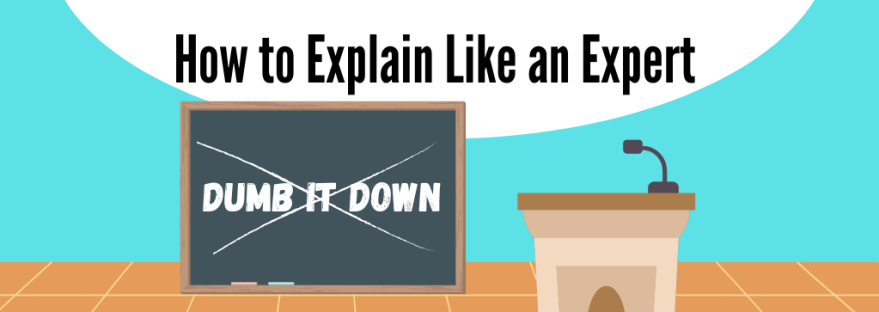
Stop Dumbing it Down
When we are experts, and we’re strategizing how to present content to non-experts, the phrase “dumb it down” inevitably comes up. This is so backwards because “dumb” and “down” are both negatives, and simplicity is anything but. Simplicity is smart, engaging, and memorable.
Resist the urge to think of simplifying as “dumbing down.” Even with the best of intentions, this mindset can cause the speaker to come across as condescending, convoluted, and unrelatable. Your audience is an expert at something, just not the same thing as you. Try this instead:
Zoom Out
Instead of “dumbing down” think of it as “zooming out.” Upwards, not downwards. When people don’t understand something, it’s often because they lack CONTEXT. When you do a puzzle, do you look at the pieces first? No, you look at the box! Because otherwise none of the pieces make sense. You can’t see where things fit if you don’t know what picture you’re making.
If someone isn’t grasping what you’re trying to explain to them, ask yourself: “Have I shown this person the BOX? Or have I only shown them the pieces.”
Let’s go back to our Star Wars analogy for a moment. What if instead the conversation went like this:
You: “So….what is this Star Wars thing all about?”
Them: “Star Wars began as a sci-fi/fantasy trilogy set in space. The main conflict is between the Galactic Empire (the bad guys) and the Rebel Alliance (the good guys.) Darth Vader is one of the main villains fighting for the Empire. Luke Skywalker is one of the main protagonists fighting for the Alliance. Midway through the trilogy, Luke learns that Darth Vader, the villain he’s been fighting this whole time, is actually his father.
In both instances, your friend was giving you a vital plot point (or huge spoiler I guess) but this second explanation makes so much more sense because it includes the needed context. It includes the “zoom out.”
Relate to Known Knowledge
When teaching someone something new, start with what they KNOW and relate it to what they DON’T KNOW. This is why analogies are so effective. Here’s an example: An optometrist was explaining a type of contact lens to me. She told me it reshapes your eye to help you see better and that it was like getting braces but for your eyeballs. Now, I’m not an optometrist, nor do I currently wear contact lenses, but I’ve both seen and worn braces on my teeth before so I could instantly conceptualize what she meant.
In your content, look for relationships and processes that are similar to other relationships and processes that would be familiar to your audience. Once they have a basic understanding THEN you can add the details. It’s a form of learning theory called “scaffolding.” You know how a new building needs scaffolding around it so it can be accessed by construction workers before it’s ready to stand on its own? Learning is the same way. You’re bringing the learner along with just enough assistance, just enough context, just enough familiarity, until they can grasp it on their own.
Draw a Picture
Whenever you can use a visual instead of words, use the visual. A good, simple visual can be so much more impactful in the right circumstances than words. It’s why I appreciated my doctor telling me my daughter was the size of an avocado when I was pregnant instead of “4 inches” because while it’s difficult for me to accurately conjure a ruler in my head, I am extremely familiar with avocados. It’s why we talk about distances in terms of “football fields,” and use bar graphs and pie charts to display numerical data. Sometimes it’s hard to grasp a concept without a picture.
If you DO choose to use a visual representation, please, please, PLEASE make it simple. If it’s a graph with words, make the words big enough to see. If it’s a picture, make the lines bold and well contrasted. If your audience can’t see the visual, they’ll be so distracted trying to figure it out that they won’t be listening to you.
Always be a Learner
Finally, one of the best ways to be a good explainer is to always be a learner. Never lose site of the frustration and subsequent exhilaration of learning something new. It’s easier to be an expert when you’re also continually acquainted with being a novice. It helps keep your perspective, and being a lifelong learner is someone that never hurt anyone!

 emilyschwartzspeaks.com